
TL;DR
- Define an auditable decision model by logging inputs, prompts, model versions, and outputs at every automation step.
- Capture context with timestamps, user identifiers, and data lineage to enable traceability.
- Apply retention and redaction policies to protect privacy while preserving explainability for audits.
- Embed explainability notes in CRM records to connect decisions with case history and human context.
- Govern and test regularly with a documented process to sustain trust and regulatory alignment.
Auditability for AI Automations: How to Prove ‘Why’ a Decision Happened
Enterprises now rely on AI automations to handle routine tasks, triage decisions, and accelerate customer workflows. But when an automated result needs justification, teams must show not just the outcome but the path to it. This article explains how to establish a rigorous Auditability for AI Automations: How to Prove ‘Why’ a Decision Happened approach. By logging inputs, prompts, model versions, outputs, and human overrides, organizations can trace decisions, diagnose errors, and demonstrate governance to regulators and stakeholders.
What to log to prove why a decision happened
Effective auditability starts with a disciplined logging scheme. At a minimum, capture the following events for each automated decision:
- Inputs — the raw data fed into the system, including any preprocessing steps.
- Prompts or system messages — what instructions the model received at runtime.
- Model version — identify the deployed model, its configuration, and any fine-tuning or adapters used.
- Outputs — the decision itself, plus confidence scores when available.
- Context — user identity, session ID, timestamps, and data source lineage.
- Human overrides — any manual changes, approvals, or rejection reasons applied after the automation ran.
Every log item should be immutable after creation and linked to a unique decision ID. This creates a stable audit trail that investigators can trace from the final outcome back to the initial signals. In practice, this means a centralized logging layer that enforces structured, schema-driven records rather than free-text notes. Structured logs enable reliable querying, correlation with other events, and automated checks for policy violations.
How to structure an audit trail: inputs, prompts, versions, outputs
Think of the trail as a chain of custody for a decision. Each link should be time-stamped and linked to the previous one. A practical structure includes:
- Event: a specific decision moment or action (e.g., loan approval check, ticket routing).
- Decision ID: a unique identifier for the decision instance.
- Input bundle: a compact, versioned snapshot of all input data fields used.
- Prompt bundle: the exact prompts or instruction sets given to the AI at runtime.
- Model descriptor: model family, version, and any configuration flags.
- Output: the decision result, with a structured payload and any scores or probabilities.
- Human action: note if a human reviewed or overridden the result, including rationale.
For organizations with multiple AI services, maintain a unified schema that standardizes fields across providers. This reduces ambiguity when auditors compare decisions across systems and supports cross-domain governance.
Retention policies and redaction in logs
Governance requires keeping enough data to explain decisions while protecting privacy. Implement clear retention policies that specify:
- Retention duration for decision logs (e.g., 7 years for regulatory visibility, shorter for day-to-day operations).
- Data minimization by logging only what is necessary for auditability.
- Redaction rules for sensitive fields (PII, financial details) that must be masked or tokenized in logs.
- Access controls to ensure only authorized personnel can view raw logs.
- Encryption at rest and in transit to protect log integrity.
Redaction isn’t a substitute for explainability. Redacted fields should be replaced with stable placeholders that preserve the ability to reason about the decision flow. For example, a redacted customer identifier can be substituted with a non-identifying token, while keeping the mapping to the original data restricted to a secure, auditable key management system.
To operationalize this, align log retention with regulatory requirements (GDPR, CCPA, SOC 2) and industry standards (ISO 27001). Regularly test retention policies in your security operations center (SOC) to ensure encryption, access controls, and data minimization rules function as intended.
Building ‘explainability notes’ into CRM records
CRM systems hold the conversations, cases, and decisions that drive customer outcomes. Integrating explainability notes into CRM records creates a single source of truth for both front-line teams and auditors. A practical approach includes:
- Linking decisions to CRM records via the decision ID, case ID, or ticket number.
- Expanding the CRM schema with a dedicated Explainability Note field that captures concise rationale, key data points, and any human override decisions.
- Capturing provenance by recording the model version and prompt details alongside the note.
- Workflow integration so explainability notes surface automatically during case review or escalation.
Embedding explainability notes in CRM records helps customer-facing teams and executives understand why a decision happened, not just what happened. It also supports faster audits, reduces back-and-forth questions, and strengthens regulatory confidence. For teams seeking practical patterns, see our guide on explainability notes in CRM for more concrete templates.
Practical example: a loan-eligibility automation
Consider a lending workflow where an AI model assesses applicant risk. A complete audit trail might include:
- Input bundle: applicant age, income, debt-to-income ratio, employment status.
- Prompt bundle: system messages instructing the model to follow regulatory guidelines and risk thresholds.
- Model version: v3.2 of the risk-scoring model with calibration applied on 2026-01-15.
- Output: risk score (0.72) and recommended action (approve with conditions).
- Context: user who initiated the decision, timestamp, and loan product type.
- Human override: underwrite team elects to require manual review due to unusual income data, with rationale logged.
When the customer subsequently asks why the decision was made, the audit trail reveals the exact inputs, the prompts given to the model, the version used, and the reason for the override. This makes it possible to explain the decision in plain terms and verify that policy constraints were respected.
Visual guidance: a recommended decision trace diagram
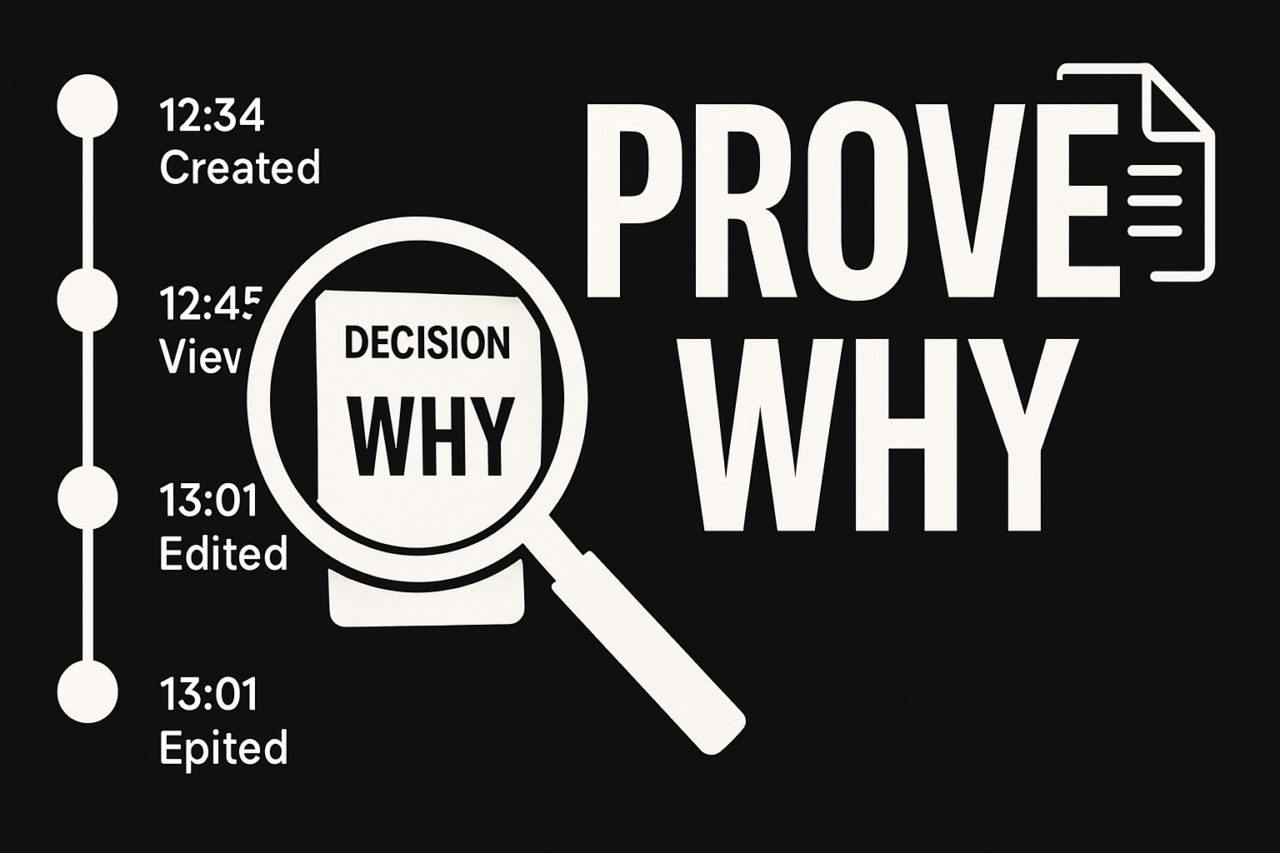
Use a simple visual to communicate the flow of a decision. A Decision Trace Diagram can map:
- Inputs →
- Prompts →
- Model Version →
- Outputs →
- Human Overrides →
- Final Decision
The purpose of this diagram is to give auditors and executives a quick, at-a-glance view of the decision path. It should be designed for clarity, with color-coding to differentiate automated steps from human interventions. You can implement this as an internal diagram in your knowledge base or as a diagram embedded in the CRM Explainability Notes field. For a ready-made template, see our article on AI audit trails.
How to support ongoing governance and audits
Auditability is not a one-off project. It requires ongoing governance and testing. Consider these steps:
- Policy documentation for data handling, retention, and redaction rules.
- Regular audits of logs and explainability notes to ensure consistency and accuracy.
- Change management processes to track when models are updated, retrained, or replaced.
- Access reviews to verify who can view full logs and raw data.
- Training programs that explain how to interpret audit trails and explainability notes.
Incorporating these practices supports data lineage, model provenance, and traceability—core components of robust AI governance and risk management. They also align with the broader move toward explainable AI and responsible automation across the enterprise.
Legal, regulatory, and industry considerations
Governance frameworks increasingly emphasize transparency and accountability. Adopt a risk-based approach that prioritizes high-impact decisions for deeper logging and stronger controls. Align your auditability program with standards such as SOC 2, ISO 27001, and sector-specific regulations. When in doubt, document the why behind decisions, not just the what, so auditors can assess the justification and consistency of outcomes.
Actionable steps to implement in your organization
Start with a practical plan that balances depth of logging with performance and privacy. Consider the following:
- Define the decision boundary to determine which tasks require full audit trails and which can use lighter logging.
- Adopt a centralized audit store that aggregates logs from all AI services and manual interventions.
- Develop standardized schemas for inputs, prompts, versions, and outputs to enable cross-system queries.
- Automate redaction for PII while preserving non-identifying data needed for traceability.
- Integrate explainability notes into CRM and case management workflows to connect decisions with business context.
For teams seeking practical templates and best practices, consult internal resources on logging best practices for AI systems and CRM explainability notes.
Conclusion: Set the foundation for accountable AI
Auditable AI is not a luxury; it is a foundation for trust, compliance, and operational resilience. By logging inputs, prompts, model versions, outputs, and human overrides; applying retention and redaction policies; and embedding explainability notes in CRM records, you create a transparent paper trail that makes decisions intelligible and auditable. Start with a clear plan, enforce a standardized schema, and iterate with regular governance reviews. The path to robust AI governance begins with the willingness to explain why a decision happened, not just what happened.
Visual note: Use a Decision Trace Diagram as a quick reference for teams and auditors. It should illustrate how inputs move through prompts to a model, produce outputs, and may involve human review before final decisions. This visual complements the written explainability notes and strengthens the overall audit narrative.
For more on related topics, explore internal resources on AI audit trails and CRM explainability notes to build a cohesive governance-and-risk program across systems.