
TL;DR
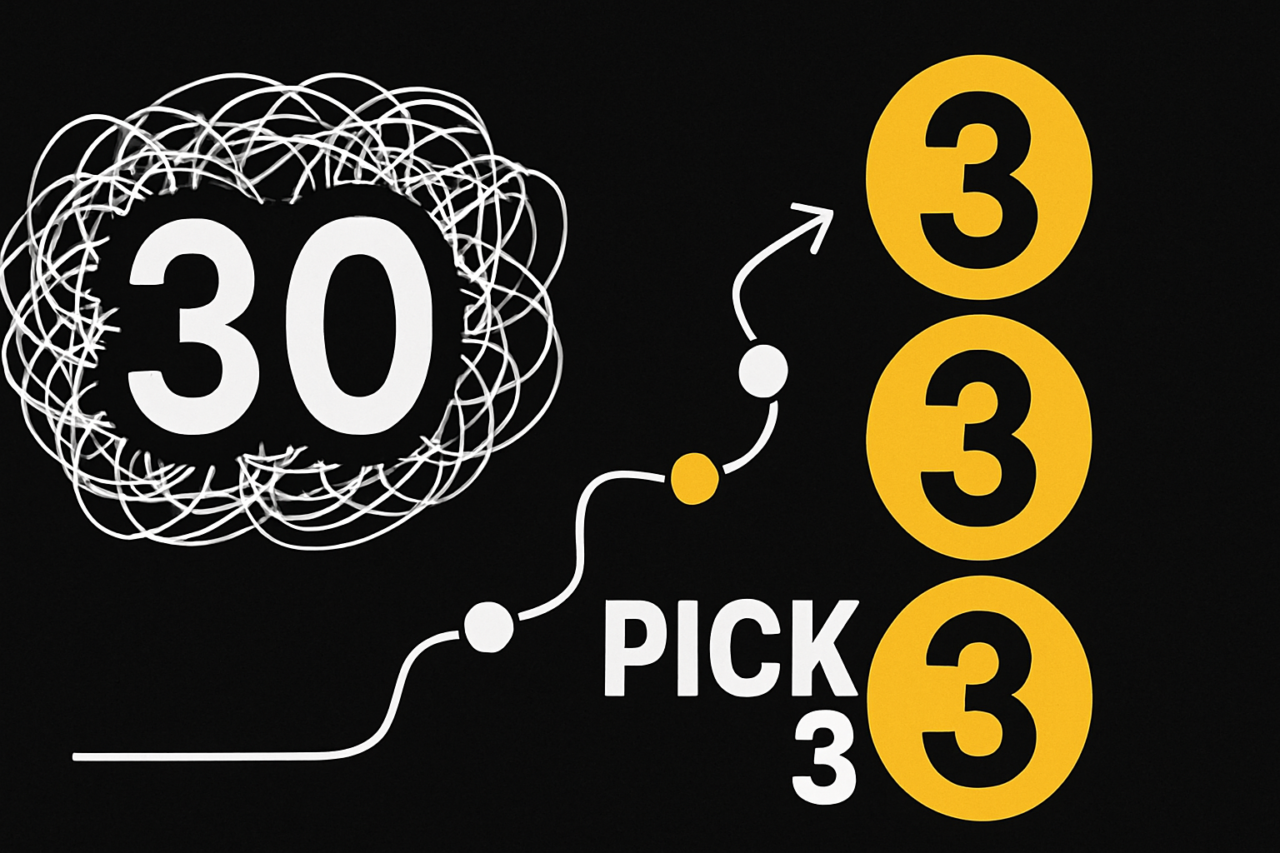
- AI Strategy for Revenue Leaders: Choose 3 Bets, Not 30 Ideas focuses your energy on three high-impact AI bets that drive revenue, not a long list of ideas.
- Use a four-factor evaluation—revenue leverage, feasibility, risk, and time-to-value—to rank explorations quickly.
- Run a structured AI opportunity workshop to capture ideas, score them, and select the top three bets.
- Turn the three bets into a 90-day roadmap with clear ownership, milestones, and metrics you can track weekly.
Leaders face an avalanche of AI possibilities. The path to revenue growth is not a browser of every clever idea; it is a disciplined choice of bets. This article explains the AI Strategy for Revenue Leaders: Choose 3 Bets, Not 30 Ideas and shows you a practical process to select three high-impact bets.
Why three bets beat 30 ideas
Decision fatigue slows progress. A long list creates uncertainty about where to begin and how to measure impact. A three-bet framework forces a tight focus on what will move revenue today and what can deliver value soon. With three bets, you gain clarity, speed, and alignment across teams.
Think of the three bets as a minimal, executable plan. Each bet represents a distinct AI initiative with a measurable outcome, a clear owner, and a known time horizon. When leadership agrees on three bets, scope narrows to what matters most and risks become manageable rather than overwhelming.
The four-factor evaluation: revenue leverage, feasibility, risk, and time-to-value
To compare ideas quickly, apply a simple scoring rubric across four factors. Score each idea from 1 to 5 on every factor, then aggregate to identify the top three bets. This keeps complexity low while preserving rigor.
Revenue leverage
Ask: How strong is the potential uplift in revenue or margin? Which customers, segments, or sales motions are affected? A top score goes to bets with a clear, sizable revenue impact and a credible path to scale.
Feasibility
Ask: Do we have access to data, talent, and technology to execute? Is an MVP viable within our current tech stack and talent pool? Higher feasibility means faster wins and lower risk of delays.
Risk
Ask: What are the operational, compliance, and reputational risks? How easily can we mitigate them? Lower risk receives a higher score, with explicit mitigation plans attached.
Time-to-value
Ask: How quickly will the initiative deliver measurable value? Bets with shorter time-to-value accelerate learning and justify continued investment.
Scoring tip: use a 1-5 scale for each factor, sum the scores, and rank. If a potential bet scores highly on revenue and time-to-value but shows moderate risk, capture the mitigation plan so it can still be considered. For reference, you can read more about prioritization methods in our Prioritization Framework.
Run an AI Opportunity Workshop
An AI opportunity workshop turns ideas into a disciplined set of bets. It aligns cross-functional teams on business goals, data readiness, and execution plans. The result is a short list of three high-impact bets with ownership and metrics ready for the 90-day roadmap.
Prep (2–3 hours before)
- Define the revenue goal for the next 12 months and a credible target for the workshop.
- Assemble a cross-functional team: Revenue, Marketing, Sales, Product, Data & Analytics, and Finance.
- Gather data on current revenue, conversion funnel, churn, and recent AI experiments.
- Provide a few example bets to anchor the discussion, but avoid pre-scripting every idea.
- Share the evaluation rubric (revenue leverage, feasibility, risk, time-to-value) so participants score consistently.
Agenda (60–90 minutes)
- Welcome and goals: state the revenue target and the three-bet objective.
- Idea capture: capture new ideas and quick wins from all participants using a shared board or digital tool.
- Quick gut checks: 60-second pitches for each idea with one slide or statement per idea.
- Scoring: score each idea on the four factors; aggregate and sort.
- Shortlist and discuss: identify up to 7 ideas that score highest; surface dependencies and risks.
- Decision: select the top 3 bets and assign owners, with one-measurement plan per bet.
- Next steps: outline the 90-day roadmap and required governance.
Practical tip: run a 90-minute, time-boxed workshop to keep momentum. Use a shared template for scoring and a live board for transparency. For a deeper dive, see our AI Opportunity Workshop guide.
Example scenario: a software company aims to grow annual recurring revenue (ARR) by 15%. The workshop surfaces three bets: (1) AI-assisted sales enablement to shorten deal cycles, (2) predictive churn reduction using customer health signals, and (3) dynamic pricing optimization for new plans. Each bet includes owner, milestones, and a KPI set to measure impact.
From ideas to a 90-day roadmap
Three bets become a concrete 90-day plan with weekly cadences, milestones, and ownership. Break each bet into 4 cycles of 3 weeks each. This yields a total of 12 weeks per bet, plus a 2–4 week buffer for integration and review.
Roadmap structure example
- Bet 1 – Owner: Head of Revenue Operations; Milestones: data pipeline verified, MVP delivered, pilot with 5 trial accounts; KPI: win rate uplift, pilot ARR.
- Bet 2 – Owner: VP of Marketing Analytics; Milestones: health scoring model validated, playbooks created, first 100 accounts scored; KPI: churn reduction, upsell rate.
- Bet 3 – Owner: Head of Product; Milestones: pricing engine prototype, integration completed, 2 pilot customers; KPI: gross margin, price realization rate.
Ownership matters. Assign explicit owners for each bet, plus a governance lead who tracks weekly metrics and reports progress to the executive team. Use a 90-day roadmap template to formalize milestones, owners, and KPIs.
To ensure accountability, embed metrics in dashboards that refresh automatically. Track leading indicators (e.g., data readiness, model accuracy, engagement with the new feature) and lagging indicators (e.g., ARR, net revenue retention). See how to structure these metrics in our ROI metrics guide.
Practical tips and potential pitfalls
- Data readiness matters. If data quality is weak, start with a safety-first MVP that validates the concept with minimal data. Delay high-stakes bets until data readiness is proven.
- Privacy and compliance come first. Ensure data use complies with policy and regional regulations before piloting any model that touches customer data.
- Incremental value beats big bets that promise long timelines. Quick wins build momentum and stakeholder confidence.
- Earth the bets in the customer journey by tying each initiative to a specific revenue moment: lead to opportunity, opportunity to win, or win to expansion.
- Learn as you go document what works, what fails, and why. This becomes your organizational knowledge base for future AI scope.
Visualization and how to use it
Visuals help communication and alignment. Suggested visuals include a 3×3 prioritization matrix showing bets by revenue impact, feasibility, and time-to-value. A roadmap timeline displays weekly milestones for each bet and a ownership chart clarifies responsibility across teams. Use a simple image like  to accompany the narrative. If you publish online, link the image to a living dashboard so readers can explore the data behind the decisions.
Internal reference: see how to craft effective visuals in our Visualization Guide.
Conclusion: take action today
By adopting the AI Strategy for Revenue Leaders: Choose 3 Bets, Not 30 Ideas, you transform chaos into clarity. Use the four-factor evaluation to screen ideas quickly, run a focused AI opportunity workshop to align stakeholders, and convert the top three bets into a concrete 90-day roadmap with owners and metrics. The outcome is a reproducible, revenue-driven AI plan rather than a collection of hopeful experiments.
Ready to start? Schedule a 60-minute AI opportunity workshop with your team, bring the four-factor rubric, and commit to three bets. Your future revenue lift depends on the choices you make today.
Internal note: reinforce the approach with behavioral playbooks and governance checklists in your next leadership meeting. For additional perspectives, explore related topics in our AI Strategy Series.