

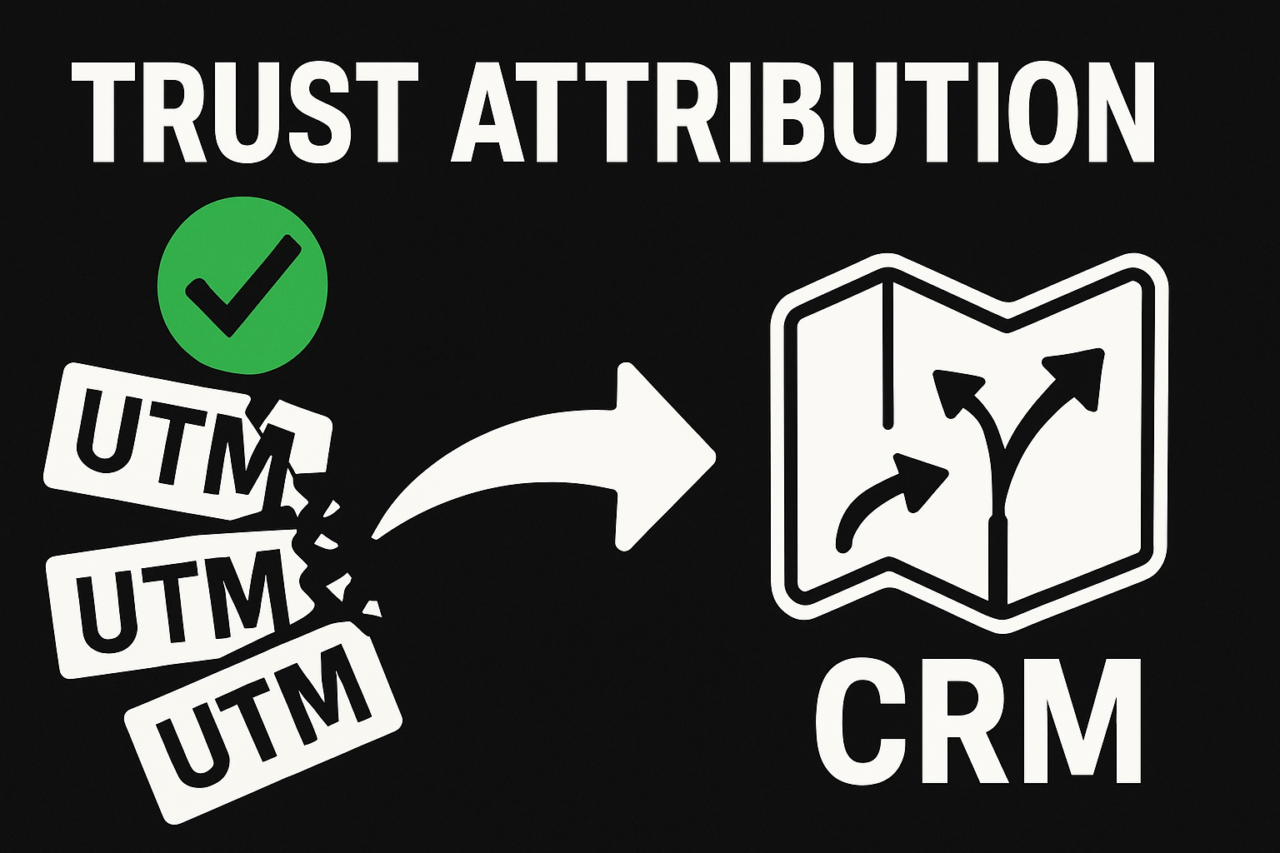
TL;DR
- Define a practical UTM taxonomy and govern CRM fields to prevent attribution gaps and data drift.
- Capture UTMs consistently on every touchpoint and map them to CRM campaign objects to create a single source of truth.
- Account for dark social with link-level tracking and forward-looking data capture to preserve attribution where referrers are hidden.
- Adopt a transparent multi-touch model for pipeline influence reporting that minimizes data swamp and bias.
Attribution Data You Can Trust: UTM Discipline + CRM Mapping
Attribution data you can trust begins with disciplined UTMs and governed CRM fields. This article outlines a practical UTM taxonomy, capture rules, and a reliable method to map data into CRM campaign objects. We also cover dark social, multi-touch models, and how to generate pipeline influence reporting without creating a data swamp. Use the guidance here to build a reproducible process that your marketing and sales teams can trust.
Think of this as a blueprint you can implement this quarter. It pairs a clear taxonomy with concrete data flows, validation steps, and governance checks. For reference, you can review our internal resources on UTM discipline guidelines and CRM mapping rules as you tailor the framework to your tech stack.
A Practical UTM Taxonomy
UTM taxonomy should be concise, predictable, and future-proof. Use a standard set of five parameters to capture the most value: utm_source, utm_medium, utm_campaign, utm_term, and utm_content. Keep values lowercase, use hyphens to separate words, and maintain a controlled vocabulary. For example, source could be google, linkedin, or newsletter; medium could be cpc, email, or social; campaign name should be descriptive but stable (e.g., spring_launch_2026). Term and content are optional but helpful for search terms and A/B tests.
Semantic variations (LSI keywords): UTM parameters, campaign tagging, source/medium/campaign mapping, canonical UTM schema, CRM campaign fields. A consistent taxonomy makes it easier to combine data from multiple channels and to reuse tags across campaigns.
To reinforce consistency, define a data governance policy that covers naming conventions, allowed values, and ownership. A simple two-tier naming convention works well: tier 1 for channel (organic, paid, email, social) and tier 2 for campaign intent (launch, webinar, nurture). This approach reduces drift and simplifies downstream reporting.
Capture Rules That Travel Across Channels
Capture UTMs at the first point of contact and preserve them as lead or contact attributes. Implement these capture rules:
- On landing pages: store UTMs in a server-side session or a first-party cookie before a form submission. Auto-fill hidden fields in forms with these values.
- On paid media: ensure ad tags pass utm_source, utm_medium, and utm_campaign to the landing page URL. Use a consistent naming convention across networks.
- In email and organic paths: embed UTMs in links or use link shorteners that preserve query strings when users click.
- For dark social: rely on the UTM-annotated link shared by users. When the link is clicked, capture UTMs from the URL at the moment of click and store them with the record.
To prevent data loss, implement server-side validation that rejects malformed UTM values and standardize a canonical set of allowed values. A small, well-defined data model reduces downstream cleaning needs and data swamp risk.
Mapping UTMs into CRM Campaign Objects
UTM data should map to CRM campaign objects or equivalent campaign records in your stack. Create a clear mapping from UTM fields to CRM fields:
- utm_source → Campaign Source (CRM)
- utm_medium → Campaign Medium (CRM)
- utm_campaign → Campaign Name (CRM)
- utm_term → Campaign Keywords (optional, for paid/search)
- utm_content → Campaign Content (optional, for A/B testing)
In practice, create a single source of truth for campaigns in your CRM. This means reusing the same Campaign record whenever a contact or lead participates in that campaign, rather than creating duplicate records. A clean, deterministic mapping makes downstream reporting reliable. See CRM mapping rules for concrete field names and examples.
Governance and Validation
Governance ensures data remains trustworthy over time. Establish ownership for UTM taxonomy and CRM fields, publish a data dictionary, and enforce validation rules at data entry points. Regular audits detect drift, such as a new utm_campaign value that diverges from the naming standard. Automated tests can flag anomalies before reports roll up to leadership dashboards. This data governance framework helps you avoid inconsistent attribution and a growing data swamp.
Dark Social, Multi-Touch Attribution, and Pipeline Influence
Attribution data quality hinges on how you handle dark social and how you model attribution across multiple touches. Dark social refers to traffic from private channels (messaging apps, email, or direct sharing) where referrer data is limited or absent. You can still attribute value by relying on pre-click UTMs and robust post-click traces. The goal is to capture the context that led to a conversion, even when the exact source remains opaque.
Dark Social: Practical Approaches
Best practices for dark social attribution include the following:
- Encourage UTM-enabled links in all outbound shares and internal communications to preserve attribution signals.
- Capture initial touch context at form submission with hidden UTM fields so you can tie the lead to the original campaign even if the user returns later from a direct URL.
- Use consistent campaign naming so that even indirect referrals can join a cohesive reporting view.
- Annotate with a last-click or last-non-direct model when appropriate, and track multi-touch paths to inform pipeline influence reports.
For teams using multi-touch attribution, ensure the model aligns with your data governance and CRM mappings. This alignment prevents over-attribution to a single source and keeps managers honest about channel performance.
Multi-Touch Attribution and Pipeline Influence
Multi-touch models assign credit across multiple interactions. A straightforward approach is to use a linear or time-decay model that weights touches by recency or order. Tie attribution to the revenue pipeline by associating campaign data with key stages in your deals. The result is a clear view of which campaigns influenced opportunities, without inflating the effect of a single touch.
When you implement multi-touch reporting, you must prevent a data swamp. Limit the number of campaign fields carried through the funnel and rely on a central campaign index to join data from ads, email, social, and organic sources. A well-designed index enables fast, accurate pipeline-influence dashboards that executives can trust.
Implementation Blueprint: A Step-by-Step Path
Below is a practical, repeatable plan you can start this quarter. Each step builds on the previous one to deliver a reliable attribution framework.
- Define taxonomy and governance. Agree on UTMs, naming conventions, and which CRM fields map to each element of the UTM set.
- Build capture mechanisms. Implement hidden fields in forms, server-side capture for landing pages, and persistent UTM storage in cookies or session data.
- Create CRM mapping rules. Map utm_source to Campaign Source, utm_medium to Campaign Medium, utm_campaign to Campaign Name, etc. Create a canonical Campaign record for each unique campaign.
- Enforce validation. Add validation rules, data quality checks, and alerting for unexpected values or missing fields.
- Pilot with a single channel. Start with one channel (e.g., paid search) to validate the workflow and reporting before expanding to all channels.
- Roll out and audit. Scale the process, run quarterly audits, and adjust taxonomy as needed to maintain consistency.
- Build dashboards. Create reports that show attribution by campaign path, source, and pipeline stage, with clear drill-down capabilities.
In practice, a pilot might track a campaign like spring_launch_2026 across Google Ads and an email nurture, then map UTMs into a CRM campaign entity and tie to opportunities in the pipeline. This concrete example helps teams see how data flows from click to close.
Visualization and Governance: How to Communicate the Value
Use visuals to communicate the data flows and ownership. A flow diagram shows how UTMs travel from touchpoints to CRM campaigns, then into opportunity records. An infographic of the UTM-to-CRM mapping provides a quick reference for new hires and external partners. A simple dashboard can display:
- Attribution by campaign name and source
- Multi-touch paths per opportunity
- Data quality metrics (missing UTMs, invalid values, drift in naming)
Internal links to related resources can anchor readers to deeper guidance. For example, link to UTM discipline guidelines when discussing taxonomy, and to data governance when outlining validation rules. These references reinforce a cohesive approach across teams.
Conclusion: Turn Data Into Trust
A well-governed attribution system is not a luxury; it is essential for credible marketing insight. By combining UTM discipline, CRM mapping, and thoughtful handling of dark social plus multi-touch attribution, you create a reliable picture of your campaigns’ true influence. Start with a clear taxonomy, enforce capture rules, and map data to CRM accurately. Then use dashboards to tell a transparent story about which campaigns move the pipeline—and why.
Take the first step by reviewing your current forms, your landing pages, and your CRM fields. If you need a quick starting point, run a mini-audit on the UTM discipline and map the results to your CRM campaign objects. A disciplined approach reduces data noise and empowers teams to act with confidence.
Visual note: Consider a diagram that maps each UTM parameter to a CRM campaign field, then shows how a lead travels through the funnel to close a deal. This helps stakeholders quickly grasp the end-to-end data flow and its impact on revenue.