TL;DR
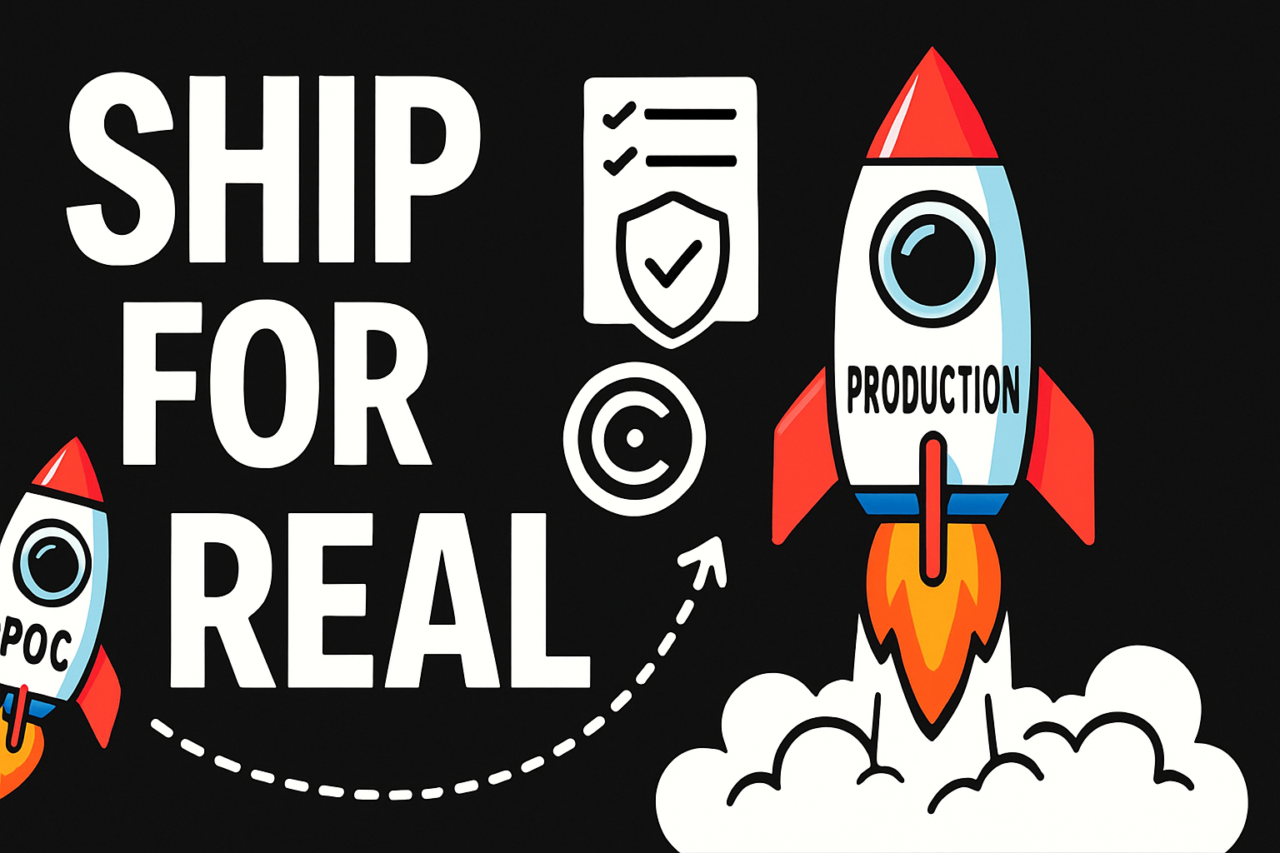
- From POC to Production: The Checklist Most Teams Skip helps teams turn a proof of concept into a reliable, governed service.
- Key areas include security review, monitoring, logging, fallback modes, documentation, training, and ownership.
- Plan the production cutover carefully to avoid disrupting existing operations.
- Establish governance and ownership from day one to ensure accountability and sustainability.
- Use a practical, step-by-step approach with real-world scenarios to bridge the gap between idea and production.
When teams demonstrate a workable proof of concept, it is tempting to ride the momentum into production. Yet production systems demand discipline beyond a flashy demo. AI services, in particular, require reliability, governance, and clear ownership to scale without breaking current operations. This article outlines a practical checklist that moves an idea from a validated POC to a live, governed service. The emphasis is on concrete, actionable steps you can implement today.
From POC to Production: The Checklist Most Teams Skip — a practical guide
POCs showcase potential. They do not automatically guarantee safety, compliance, or maintainability. The transition to production should be a structured process that codifies risk controls, operational practices, and clear lines of responsibility. In this guide, you will find a balanced approach that preserves speed while adding rigor. We will cover security review, monitoring and logging, fallback modes, documentation, training, and ownership, plus a plan for the production cutover that minimizes disruption to ongoing operations.
1) Security review: build it in early
Security cannot be an afterthought. Start with threat modeling that focuses on data, model drift, and adversarial inputs. Establish that data handling complies with policies, privacy, and regulatory requirements. Create a lightweight yet robust assessment that covers access controls, secrets management, and secure deployment pipelines. If you operate in regulated domains, align with your control framework and produce an auditable trail. For practical guidance, see our security review guidance and ensure it translates into concrete, testable checks in your CI/CD pipeline.
2) Monitoring and observability: know what matters
Production AI systems require real-time insight into performance, reliability, and drift. Define a minimal observability stack: metrics, traces, and logs that answer critical questions about latency, accuracy, and data quality. Establish service level objectives (SLOs) and error budgets to quantify acceptable risk. Implement dashboards that surface anomalies quickly and route alerts to the right on-call owners. Integrate observability for AI models into the daily operations routine so teams act fast when issues arise.
3) Logging and data lineage: the evergreen record
Consistent logging is essential for debugging and compliance. Capture input data snapshots, model versions, feature pipelines, and prediction outcomes. Maintain data lineage to trace how a decision was made from raw input to final result. Ensure logs are secure, tamper-evident, and protected by access controls. A strong logging foundation makes audits smoother and accelerates incident response.
4) Fallback modes and resilience: prepare for the inevitable
No system is perfect. Design fallback modes that preserve safe behaviors when a component fails. Options include graceful degradation, reduced feature sets, or a switch to a rule-based fallback when a model is unavailable. Define clear rollback procedures, automated retries with backoff, and circuit breakers to prevent cascading failures. The goal is to maintain user experience and safety even under stress.
5) Documentation and training: transfer knowledge, reduce risk
Documentation should cover deployment steps, incident handling, runtimes, and governance policies. Produce runbooks that ops teams can follow during outages, not just during normal operation. Train teams on model governance, data security, and change management. Good documentation accelerates onboarding, improves cross-team collaboration, and lowers the chance of misconfigurations during updates. Consider a living documentation approach that evolves with the system.
6) Ownership and governance: assign clear responsibility
Ownership should span data, models, code, and deployments. Assign accountable owners for each domain: data stewardship, model risk, deployment reliability, and user-facing features. Establish decision rights for model updates, versioning, and deprecation. Governance policies should be explicit, auditable, and aligned with business risk tolerances. When teams know who decides, they move faster with fewer handoffs and less drift.
7) Production cutover planning: a safe, staged transition
Cutover planning is where many projects stumble. Start with a release plan that includes a phased rollout, a rollback path, and a defined success criterion. Use a shadow deployment or canary release to compare the new system against the current one under real traffic, without impacting users. Prepare a rollback script and automated tests that verify the old system remains healthy during the transition. Document monitoring thresholds and alert routing for the cutover window to ensure rapid intervention if problems appear.
8) Practical example: a customer-support AI assistant
Imagine a customer-support chatbot powered by a production AI system. During the POC, the team validated intent recognition and response quality using a curated dataset. In production, they add strict access controls for customer data, logs every interaction with user identifiers masked, and monitors model drift as new customer queries arrive. They implement a fallback to a human agent if confidence drops below a threshold. They publish a runbook for incident response, train the support team on the bot’s governance, and assign clear owners for data, privacy, and deployment. The phased rollout begins with a small subset of traffic and a rapid rollback path if user satisfaction drops or latency rises beyond the agreed limit.
9) Implementation tips: practical steps you can apply now
- Convert the POC into a lean production plan with explicit success criteria and a cutover timeline.
- Create a simple risk register focused on data quality, model performance, and security gaps.
- Automate checks for data drift and model health as part of CI/CD with a clear escalation path.
- Document the ownership map: who approves changes, who handles incidents, and who maintains compliance artifacts.
- Schedule a rehearsal of the production cutover to surface gaps and training needs.
Taking this approach helps teams avoid common pitfalls: a rushed deployment, unclear ownership, and gaps in monitoring and governance. By treating production readiness as an integral part of the project plan, you reduce risk and speed up reliable delivery.
Visual aid: plan the transition with a simple diagram
Consider a production cutover flowchart that maps the steps from staging to production, including data checks, model validation, security sign-offs, and rollback procedures. A visual like this clarifies responsibilities, shows dependencies, and makes risk points visible to leadership. The diagram should illustrate three lanes: staging validation, production shadowing, and live deployment, with gates at each stage to gate progress. Use the visual as a companion to the rollout plan and runbooks.
Putting it together: a concise workflow
1) Define scope and success criteria for production. 2) Build a security and data governance plan. 3) Implement observability and logging foundations. 4) Prepare fallback modes and incident playbooks. 5) Create runbooks and training materials. 6) Plan a staged cutover with a clear rollback path. 7) Execute a rehearsal and gather feedback. 8) Move to production with continuous monitoring and iterative improvement.
For additional example playbooks and reference templates, see our related resources on AI operations playbooks and data governance for AI.
In practice, From POC to Production: The Checklist Most Teams Skip emphasizes that a successful transition requires deliberate planning, measurable controls, and clear ownership. It is not enough to prove the concept; you must also prove that you can operate it safely, securely, and sustainably at scale. When teams adopt this mindset, they reduce risk, improve reliability, and deliver real business value faster.
Suggested visual: a production cutover flowchart showing staging validation, production shadowing, and live deployment gates, with clear owners at each stage. This helps teams align on responsibilities and detect potential issues before they affect users.
As you prepare your next AI service, remember that the most successful transitions combine speed with rigor. A well-defined checklist makes the difference between a promising prototype and a trusted production system.
In closing, the journey from a successful POC to a resilient, governed production service is not a single leap but a series of deliberate, verifiable steps. From POC to Production: The Checklist Most Teams Skip is a roadmap you can adapt to your organization, ensuring that your AI systems deliver consistent value without compromising security, reliability, or governance.
Ready to start? Map your current project against the checklist above and identify three concrete areas to improve today. If you want a starter template, we have a lightweight, editable plan you can customize for your environment.
In practice, From POC to Production: The Checklist Most Teams Skip.