TL;DR
- From POC to Production: The Checklist Most Teams Skip explains why live AI services need more than a working prototype.
- Security review, observability, and governance are guardrails that prevent surprises after launch.
- Plan the production cutover carefully to avoid disruption and enable quick rollback if needed.
- Documentation, training, and clear ownership ensure accountability and smooth operation.
Moving from a proof-of-concept to a production AI system is a different problem. POCs prove ideas; production proves reliability. The gap is governance, not just code. In this article, we’ll walk through a practical From POC to Production: The Checklist Most Teams Skip that helps teams ship AI services with confidence. We’ll cover security reviews, monitoring and logging, fallback modes, documentation, training, and ownership. We’ll also show how to plan a production cutover so you don’t break existing operations.
From POC to Production: The Checklist Most Teams Skip — Why production readiness matters
POCs focus on functionality. Production requires stability, resilience, and clear governance. AI systems run in real environments with data drift, evolving user needs, and potential adversaries. Treat production as a different lifecycle with gates, reviews, and runbooks. This mindset reduces risk and speeds recovery when incidents occur.
Key terms to keep in mind include production readiness, observability, and change management. They help you measure what matters and act quickly when something fails. For teams building AI-enabled services, readiness is not a one-time checklist; it’s a continuous discipline.
1) Security review and risk assessment
Security is not optional once you deploy. It needs to be baked in from the start. Begin with a threat model that maps actors, data flows, and critical assets. Identify data-access controls, encryption in transit and at rest, and key management practices. Document who can deploy, who can access live data, and how secrets are stored.
Actions you can take now:
- Conduct a risk assessment for data used by the AI model, including PII and sensitive business data.
- Review authentication, authorization, and auditing (AAA) policies for all services involved in the AI workflow.
- Enforce least privilege on model serving endpoints and data stores.
- Run a security review with a cross-functional team, including security, privacy, and product owners. Learn more in our security review guide.
Security isn’t a one-off task. It’s a cycle of assessment and improvement. Align security reviews with your release cadences so new models, features, or data sources undergo the same scrutiny as the initial build.
2) Observability: Monitoring, logging, and alerting
Observability turns problems into action. Without it, you’re guessing why a service failed or drifted from expected behavior. Establish a baseline for latency, error rates, data quality, and model drift. Ensure logs capture enough context to diagnose issues without exposing secrets.
Practical steps:
- Instrument the AI service with end-to-end monitoring across data ingestion, model inference, and downstream effects.
- Implement structured logging and alerting on critical thresholds (latency spikes, accuracy drop, or data quality issues).
- Set up a dashboard that surfaces key risk indicators and helps on-call teams triage quickly.
- Document runbooks for common incidents and failure modes. If you want a detailed reference, see our observability guide.
LSI keywords: production monitoring, model drift tracking, log management, operational telemetry.
3) Fallback modes, rollback plans, and incident response
No production deployment is risk-free. Build in fallback modes so user impact is minimized during failures. A rollback plan should be readily executable and tested before go-live. Include both application-level rollbacks (feature flags) and data-level rollbacks (reverting data migrations or model versions).
Key practices:
- Use feature flags for safe, behind-the-scenes toggling of AI features.
- Prepare a canary or blue-green deployment strategy to limit exposure to a subset of users.
- Define a rollback playbook with steps to revert to the previous model version and data state.
- Run incident drills to validate your response process and reduce reaction time during real events.
Link to example runbooks and templates in our repository to tailor to your stack. Internal reference: Incident response for AI services.
4) Documentation, training, and ownership
Clear ownership accelerates decisions and accountability. Define who is responsible for model selection, data governance, deployment, and on-call duties. Documentation should cover model purpose, data sources, performance metrics, and escalation paths. Training teams to interpret AI outputs reduces the risk of misinterpretation or misuse.
What to document and train for:
- Model scope and limitations, including edge cases and failure modes.
- Data governance policies and data-retention rules that apply to the production service.
- Deployment criteria, including approval gates and rollback conditions.
- On-call schedules and runbooks for common incidents.
Ownership should be explicit. Consider a RACI model (Responsible, Accountable, Consulted, Informed) for deployment, monitoring, and incident response. Link to our guide on ownership and governance to operationalize accountability in your teams.
5) Production cutover planning: How to plan without breaking operations
The pivot from staging to production is where most teams stumble. A well-planned cutover minimizes disruption and keeps existing operations stable. Here is a practical, repeatable approach.
- Define a cutover window: Schedule during low-traffic hours and communicate with all stakeholders. Reserve time for validation and rollback if needed.
- Prepare a canary rollout: Release to a small, representative user segment before full exposure. Monitor business and technical KPIs.
- Enable feature flags to turn AI capabilities on or off without redeploying code.
- Establish data migration controls: Validate schema changes, data mappings, and backups. Run a parallel data path if possible.
- Have a rollback plan: Predefine conditions that trigger a rollback and rehearse the steps with the on-call team.
- Validate end-to-end: Ensure data flow from input to AI output to downstream systems remains correct after cutover.
In practice, many teams pair a blue-green deployment with continuous verification. This approach allows you to switch traffic gradually while the older environment remains live as a safety net. See how we applied a blue-green strategy in a recent AI-service rollout in our deployment patterns post.
6) Data governance and privacy considerations
AI systems often handle sensitive data. Protect privacy and comply with regulations by designing data flows with privacy by design. Anonymize or pseudonymize data where possible. Document provenance so you can trace data to its origin and track model inputs that influence decisions.
Practical steps include:
- Limit data access strictly to what is needed for inference.
- Use data retention policies that align with business and regulatory requirements.
- Implement data drift monitoring to catch changes in input data distribution that could affect model quality.
Combining governance with security reduces risk and improves trust with users. For more on privacy practices in AI, check our privacy-by-design guide.
7) Practical example: AI service for customer support
Imagine an AI-powered customer support assistant deployed across a mid-size retailer. The POC demonstrated fast responses and reduced handle time. The production checklist, however, elevated the project from a prototype to a reliable service. Security reviews identified PII handling in chat logs and shaped encryption and access controls. Observability dashboards tracked response latency and drift in user questions, triggering alerts when model accuracy fell below a defined threshold.
The team used a canary rollout to test the assistant with a subset of users and employed a feature flag to disable the assistant if issues arose. A documented runbook helped the on-call team revert to the human-staffed channel within minutes, avoiding service disruption. Ownership was assigned to a cross-functional squad, with clear responsibilities for data governance, incident response, and deployment. This practical progression demonstrates how the checklist translates POC success into live service reliability.
If you’d like a concrete template for this scenario, see our example playbooks in the AI service runbooks.
8) Visuals and tools to guide your team
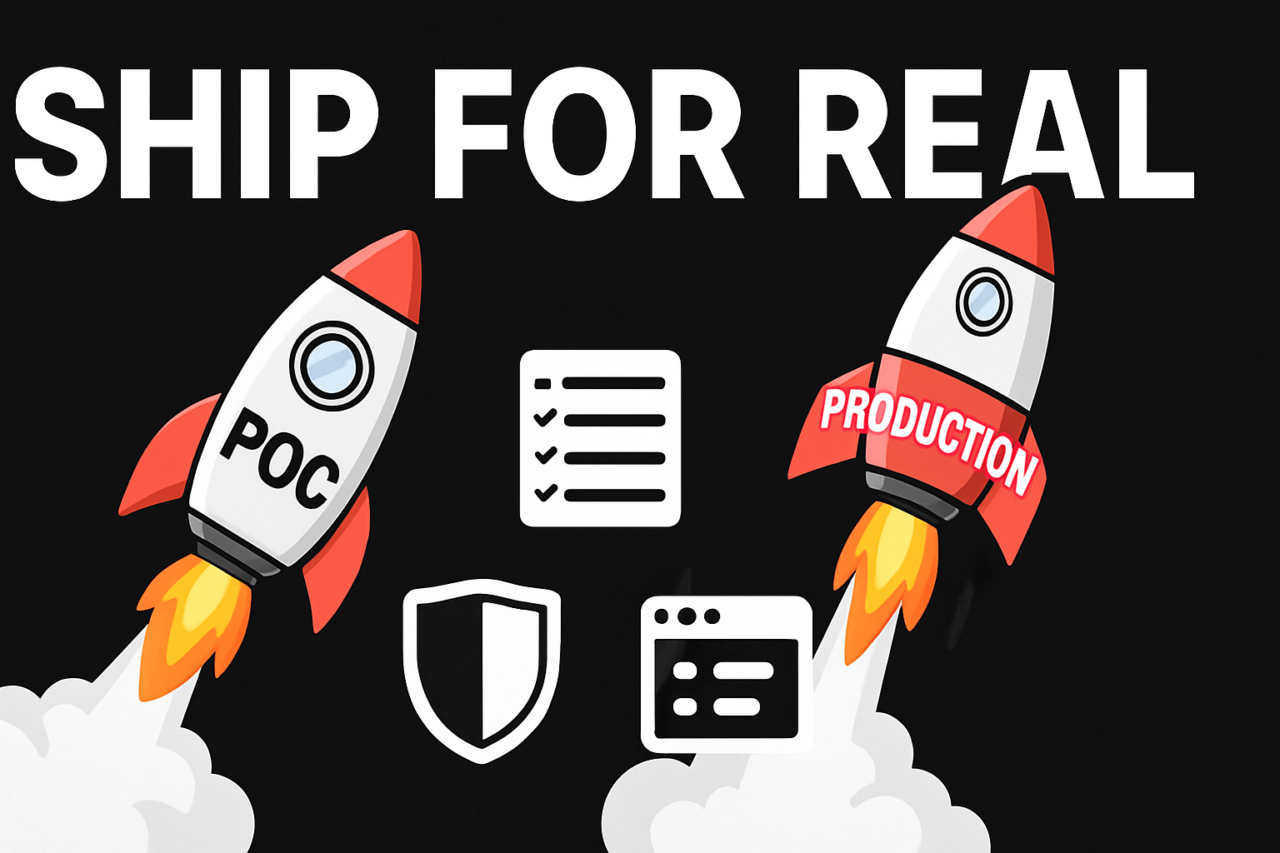
Visuals help teams align around the same plan. Consider creating a simple production readiness infographic that shows the lifecycle: PoC → staging → production, with gates for security, observability, and governance. This diagram can be your shared reference during reviews and handoffs. A well-designed chart clarifies responsibilities and reduces ambiguity during critical moments.
We recommend pairing visuals with lightweight tooling: a centralized dashboard for KPIs, a security checklists, and runbooks in a version-controlled repository. If your team uses a documentation platform, link to the living checklist so it stays current as you evolve the AI service.
Conclusion: From POC to Production: The Checklist Most Teams Skip
Successfully moving AI systems into production is less about the code and more about the governance, monitoring, and operational discipline around it. By embedding a security review, observability, fallback plans, and clear ownership into your process, you create durable, reliable services. The production cutover becomes a controlled, repeatable event rather than a leap into unknown risk.
As you adopt this checklist, remember that readiness is ongoing. Establish feedback loops to refine data quality, model performance, and incident response. Treat each deployment as a learning opportunity that strengthens your entire organization’s ability to deliver trustworthy AI services. If you’re ready to start, map your current POC to a production plan using the steps outlined above, and link these practices to your existing governance framework. And if you want to explore related topics, visit our related guides on security review, observability, and ownership and governance.
Takeaway: The journey from POC to production is a disciplined process. With a formal checklist for security, observability, fallbacks, documentation, training, and ownership, your AI services can scale safely and reliably.
Suggested visual: Production readiness flowchart
Purpose: Provide a quick, shareable reference of gates from PoC to production, highlighting security reviews, observability checks, and cutover steps. It helps teams quickly assess readiness during reviews and onboarding.