TL;DR
- Model Choice for Enterprises: Public LLMs vs Private Endpoints vs Local Models defines how you balance cost, latency, privacy, customization, and governance for each workload.
- Public LLMs are often low upfront cost and fast to deploy but raise privacy and governance questions for sensitive data.
- Private hosted endpoints give you control and compliance alignment, with moderate total cost and latency trade-offs.
- Local models offer maximum data sovereignty and customization, but require hands-on maintenance and hardware planning.
- Use the decision checklist to map workloads to the right model type, then pilot with concrete metrics for RevOps workflows like summarization, classification, and enrichment.
The choice among Public LLMs, private hosted endpoints, and local models hinges on governance and risk as much as on cost and performance. This article outlines the tradeoffs across cost, latency, privacy, customization, and governance, and provides a practical decision checklist. It also includes concrete RevOps workflow examples so you can map real workloads to the right deployment model.
Throughout, you’ll see references to common enterprise concerns such as data residency, auditability, and role-based access. For actionable guidance on governance and risk, see our related coverage like governance and risk. For RevOps workflows, explore our guide on RevOps workflows and privacy best practices.
Model Choice for Enterprises: Public LLMs vs Private Endpoints vs Local Models — What It Means
Choosing the right model architecture starts with workload intent. Some tasks benefit from broad coverage and rapid experimentation, while others demand strict data control and reproducibility. The Model Choice for Enterprises: Public LLMs vs Private Endpoints vs Local Models framework helps you weigh the tradeoffs in a structured way and align deployment with governance policy from day one.
Cost and total cost of ownership (TCO)
Public LLMs typically offer a pay-as-you-go model that scales with usage. This can be attractive for teams that run infrequent tasks or pilots and want to avoid large upfront commitments. The downside is ongoing per‑token or per‑request costs that can accumulate as usage grows, especially for RevOps tasks that process large documents or run frequent classification jobs. In contrast, private hosted endpoints and local models shift more cost into infrastructure and maintenance but can yield predictable monthly spend and potential savings at scale. When you evaluate Model Choice for Enterprises: Public LLMs vs Private Endpoints vs Local Models, model pricing must be balanced against availability of internal staff, hardware, and licensing requirements. Internal cost models should include inference costs, data transfer, monitoring, and security tooling. If privacy is a top constraint, the premium for private or local deployments may be justified by reduced data leakage risk and easier compliance reporting.
Tip: run a small-scale TCO analysis that compares a 6–12 month horizon across the three paths for your top 3 RevOps use cases. Include data-transfer costs, model call volumes, storage needs, and staffing time for governance tasks. See how each option scales with peak workloads and how licensing affects long-term budget planning.
Latency and throughput
Latency matters when RevOps teams rely on quick turnarounds for dashboards, alerts, or customer-facing responses. Public LLMs tend to deliver the lowest fixed latency when you measure end-to-end time from request to answer, especially for shorter prompts. However, network routing, API throttling, and queue contention can introduce variability. Private hosted endpoints reduce external dependencies and can offer lower, more predictable latency with controlled traffic. Local models eliminate network latency entirely, but you pay in compute time and data movement for complex prompts. If your operation demands real-time guidance, a hybrid approach—public for light tasks and private or local for sensitive, fast-path workloads—often makes the most sense. In Model Choice for Enterprises: Public LLMs vs Private Endpoints vs Local Models, latency should be a primary measurable in pilot tests and contract negotiations with vendors.
Privacy, data residency, and governance
Privacy is the most salient driver for many enterprises. Public LLMs introduce data risk: prompts or documents may traverse external networks or be retained by external providers. Private hosted endpoints give you control over data ingress/egress, access policies, and retention rules, which helps with governance and regulatory alignment. Local models maximize data sovereignty; data never leaves your environment, which simplifies privacy impact assessments and audit trails. The governance overhead is higher for local models, as you must manage updates, security patches, and model drift. In Model Choice for Enterprises: Public LLMs vs Private Endpoints vs Local Models, privacy and governance are not afterthoughts—they shape licensing, data handling, and access controls from the outset.
Customization, control, and risk management
Public LLMs offer quick value with off-the-shelf capabilities and rapid experimentation. Customization stays somewhat limited to prompts, few-shot examples, and retrieval augmentation. Private endpoints provide better customization through fine-tuning, adapters, and control over the inference stack, while still leveraging a managed service. Local models enable the deepest customization: you can fine-tune on proprietary data, implement strict guardrails, and integrate directly with internal data lakes. The trade-off is in maintenance: updates, monitoring, and security become ongoing responsibilities. When evaluating Model Choice for Enterprises: Public LLMs vs Private Endpoints vs Local Models, map your risk tolerance to your desired level of control and determine who owns the lifecycle.
Deployment Scenarios and Workflows
Not all workloads require the same model approach. The optimal mix often mirrors the workload mix: light, non-sensitive tasks on public LLMs; sensitive or regulated tasks on private endpoints; and fully bespoke processing on local models. Consider the following practical scenarios and align them with the corresponding model type.
RevOps workflows: Summarization, Classification, Enrichment
Summarization of customer inquiries or support tickets can be cheap and fast on public LLMs when data is non-sensitive. For cases with regulated content, route to a private endpoint to enforce data policy. For highly sensitive content, use a local model with strict privacy controls to generate summaries anchored to internal taxonomies.
Classification tasks (e.g., lead scoring, intent detection) often benefit from a private endpoint due to the repeatable, rule-like outputs and easier auditing. Local models can be used when you require fully governed decision logic with auditable feature inputs and deterministic results.
Enrichment—pulling in external data like firmographics, purchase history, or CRM attributes—can be mixed. Use public LLMs for broad enrichment at scale, private endpoints for compliance-laden enrichment, and local models to fuse internal data with external signals under strict governance. For more on practical workflows, see our RevOps workflows.
In practice, most enterprises adopt a hybrid model. A common pattern is to process non-sensitive data with a Model Choice for Enterprises: Public LLMs vs Private Endpoints vs Local Models backbone, then funnel sensitive or regulated content through a private endpoint or a local model. This preserves agility while maintaining governance discipline.
Decision checklist
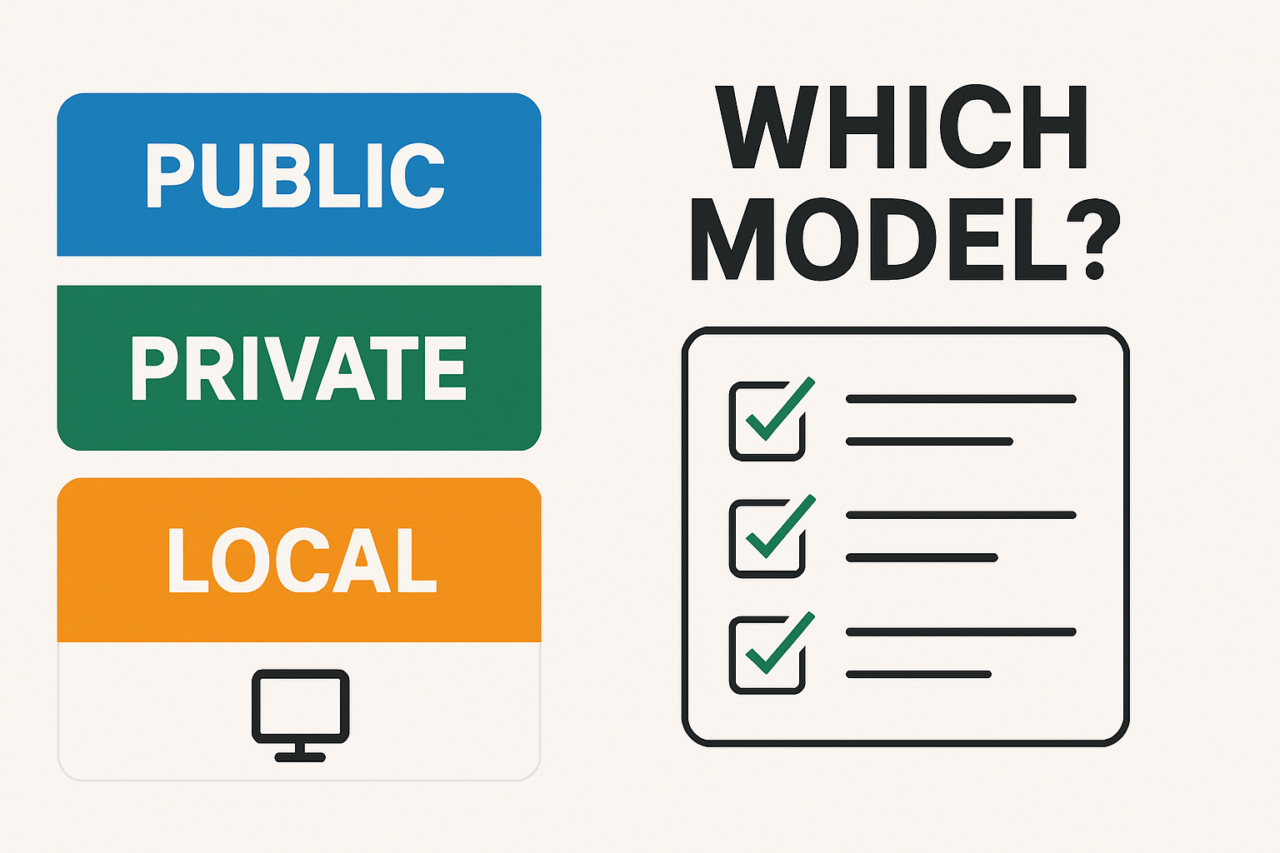
- Data sensitivity Is the data inherently sensitive or regulated? If yes, lean toward private endpoints or local models.
- Privacy and compliance Do you need strict data residency and auditable trails? Favor private endpoints or local models with explicit retention policies.
- Cost profile Can you tolerate variable seasonal costs, or do you need predictable budgeting? Private or local deployments offer more control over spend.
- Latency requirements Do you need sub-second responses? Local models remove network latency, but require compute planning.
- Customization needs Do you require fine-tuning or strict guardrails? Local or private endpoints provide deeper customization capabilities.
- Governance and auditing Can you implement robust monitoring and access control in-house? Local and private paths enable stronger governance.
Use this checklist at project kickoff. It helps you map each RevOps workload to the most appropriate model path and identifies gaps to close before deployment. For a guided approach, pair the checklist with an internal policy document that codifies data handling, access control, and incident response.
Practical guidelines and pilot tips
Start with a light pilot that tests Model Choice for Enterprises: Public LLMs vs Private Endpoints vs Local Models across 2–3 non-sensitive use cases. Define success by accuracy, latency, and governance metrics, not just model quality. Use a three-axis scorecard: performance, privacy, and control. Document decisions and create a reusable template for future deployments. Internal teams will appreciate a clear map of when to use which model type, backed by data.
Infuse pilots with guardrails: establish prompt policies, content filters, and audit logs. For private endpoints and local models, document how you handle updates and drift management. Consider retrieval-augmented generation (RAG) as a way to keep models fresh while using internal data stores under governance rules. For visual learners, a simple Model Choice for Enterprises: Public LLMs vs Private Endpoints vs Local Models diagram can speed buy-in across leadership.
Suggested visuals
Infographic idea: a 3-column, capability-based chart comparing Public LLMs, Private Endpoints, and Local Models across Cost, Latency, Privacy, Customization, and Governance. Include a row for common RevOps tasks (Summarization, Classification, Enrichment) showing recommended path per task. Purpose: enable quick decisions during planning and executive review.
Another helpful visual is a governance and risk workflow diagram that shows data flow, access controls, and audit points across the three deployment options. Describing how data travels, where it is stored, and how it is monitored helps non-technical stakeholders grasp the governance implications quickly. For more on the governance side, see the linked material on governance and risk.
Conclusion: Choosing the right mix for governance-forward enterprises
In the end, there is no one-size-fits-all answer for Model Choice for Enterprises: Public LLMs vs Private Endpoints vs Local Models. The best approach combines the strengths of each path to fit specific workloads, risk tolerance, and governance requirements. Public LLMs can accelerate discovery and scale for non-sensitive tasks. Private endpoints offer strong control and compliance alignment for teams handling regulated data. Local models deliver maximum data sovereignty and customization, with the caveat of ongoing maintenance and infrastructure planning.
Start with a clear governance framework, map your RevOps workloads to the right model type, and pilot with measurable criteria. Build an evidence-based road map that evolves as needs change and as new capabilities emerge. By embracing a deliberate mix, you can unlock AI value while preserving the rigorous governance posture your organization requires. If you’re starting from scratch, a practical first step is to run a 90-day pilot focusing on three core RevOps tasks: summarization, classification, and enrichment, and to document everything in a single governance notebook. This creates a repeatable process for future deployments and keeps risk in check.
Ready to design a model strategy that aligns with your risk, cost, and performance targets? Begin with a practical checklist, consider your likely workload mix, and engage stakeholders across security, privacy, finance, and operations. The path you choose today sets the foundation for trusted AI use across the enterprise.