

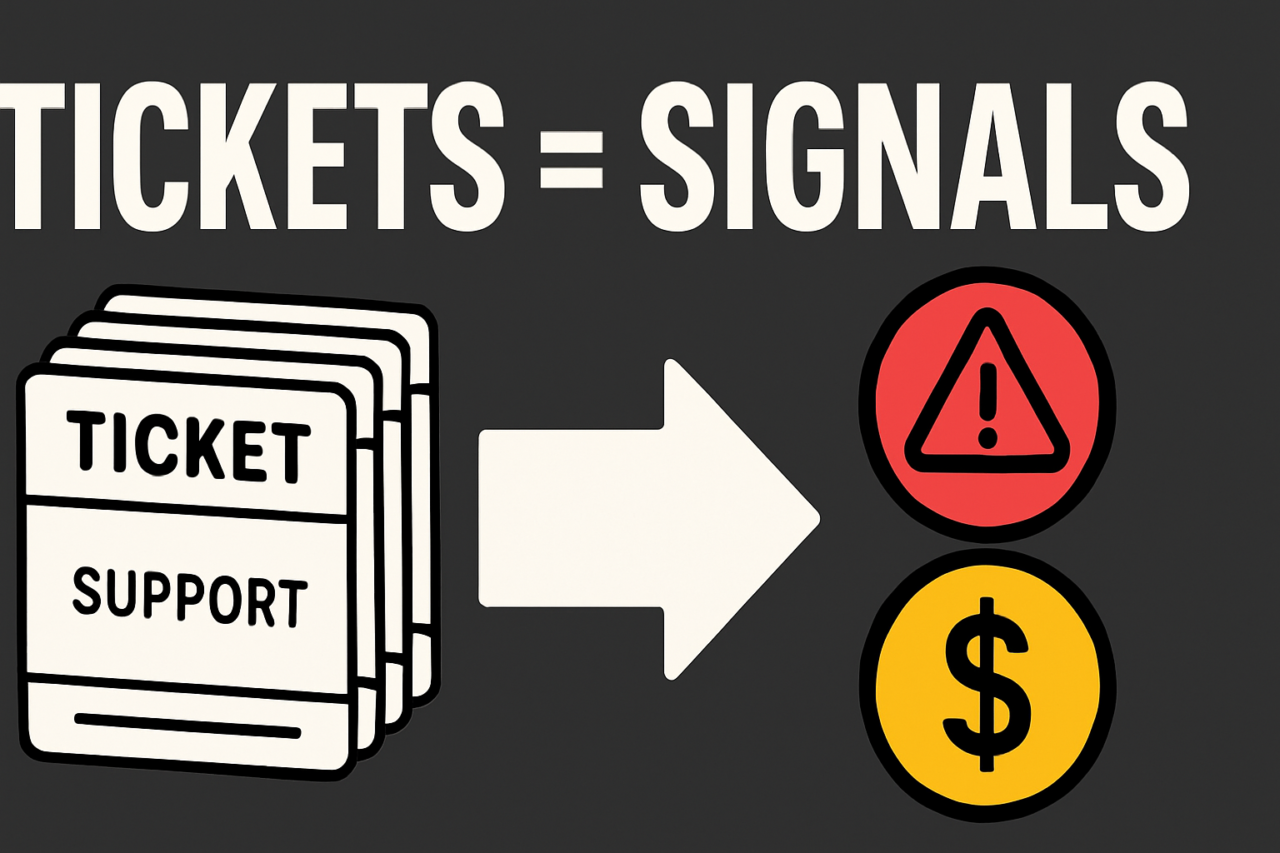
TL;DR
- Support tickets as revenue signals become forecasts for churn or expansion when themes and timing are analyzed.
- Classify ticket themes to map customer pain to revenue outcomes. Onboarding gaps, adoption friction, and pricing confusion are key signals.
- Measure time-to-resolution and sentiment to gauge adoption challenges and its link to retention.
- Route insights to CS plays and the product backlog with clear, measurable outcomes.
- Use visuals to tell the story: a ticket-to-pipeline map that connects pain to pipeline opportunities.
What are revenue signals from support tickets?
Customer success teams live at the intersection of value and risk. Support interactions capture this dynamic in real time. When we label tickets by theme and watch outcomes, pain points become signals that forecast revenue opportunities. In practice, a surge in onboarding questions can predict churn risk, while recurring requests for a new capability or a billing inquiry can flag expansion potential. The net effect is a data layer that links everyday support activity to revenue impact.
Viewed through a revenue lens, support tickets as revenue signals emerge from patterns in volume, timing, and resolution. The early warning signs are not just about unhappy customers; they are about whether customers realize value quickly enough to stay with the product. This perspective helps CS leaders align actions with measurable gains.
Why tickets predict churn and expansion
Churn tends to happen when friction blocks value. Tickets that linger or escalate often signal a path to renewal risk. Conversely, tickets that resolve quickly and yield constructive outcomes can indicate healthy adoption or even growth.
Two metrics matter here: time-to-resolution (TTR) and sentiment. A short TTR paired with positive sentiment correlates with higher retention. Long TTR, especially on critical paths like onboarding or data integration, correlates with churn risk and potential downgrades. By tracking both metrics, teams can distinguish between isolated issues and systemic problems that affect revenue.
Classifying ticket themes to unlock insights
A consistent taxonomy makes tickets actionably linkable to business outcomes. Start with a manageable set of themes that map to product and customer journeys. Examples include onboarding friction, feature gaps, reporting or analytics issues, integration challenges, pricing or billing confusion, and performance problems.
Taxonomy example:
- Onboarding and time-to-value hurdles
- Adoption friction for key features
- Reporting and analytics gaps
- Integration and data-sync problems
- Billing, pricing, or contract questions
- Product defects or performance issues
Label tickets consistently and capture context like user segment, plan, and usage intensity. Use a lightweight scoring system to highlight high-priority themes. For example, a surge in onboarding tickets from a specific product cohort signals a broader adoption issue; a cluster of expansion-related tickets around a feature set signals growth potential. See how customer-success metrics tie into these themes for holistic health scores.
Measuring time-to-resolution and impact on retention
Time-to-resolution matters because velocity often reflects customer patience and perceived value. TTR is the time from ticket creation to final resolution. Shortening TTR typically improves CSAT and decreases churn risk. Pair TTR with sentiment data from post-resolution surveys to get a fuller picture of outcomes.
Beyond speed, analyze escalation paths. Are issues staying at the frontline support level, or do they require cross-functional work? Tickets that require product or engineering involvement may signal deeper product gaps or adoption friction. Tracking escalation frequency helps quantify the cost of friction and the potential upside of addressing root causes in the backlog.
From insights to CS plays and product backlog
Turn ticket insights into repeatable actions. Two parallel workflows help translate pain into revenue signals:
- CS plays: Proactive adoption sessions, renewal risk alerts, QBRs focused on value realization, and targeted health checks based on ticket themes.
- Product backlog: Prioritized improvements tied to ticket themes, such as onboarding flow tweaks, reporting enhancements, or integration fixes. Each backlog item should have a clear hypothesis, success metrics, and a link to a revenue outcome (retention uplift or expansion potential).
Example: a wave of onboarding tickets about a slow first value leads to a backlog item for an onboarding wizard and a proactive implementation guide. If this reduces time-to-value by 20%, you can attribute a portion of that improvement to higher renewal probability and influencing expansion signals. Link these items to measurable outcomes in your product roadmap dashboard for visibility across teams.
CS plays: practical drills
Build a playbook that translates themes into concrete actions:
- Trigger a proactive onboarding session when onboarding friction tickets exceed a threshold.
- Flag expansion opportunities when tickets reference a feature set not included in the current plan.
- Escalate pricing or contract questions to a renewal specialist to prevent churn at the point of value realization.
- Schedule quarterly value reviews for high-risk cohorts, with success metrics tied to adoption milestones.
Product backlog: feeding the roadmap
Link ticket themes to backlog items with hypotheses and expected revenue impact. For each item, specify:
- Problem statement
- Rationale tied to ticket data
- Metric of success (e.g., renewals, upgrade rate, time-to-value)
- Owner and deadline
Over time, you will see a direct line from support-driven insights to product improvements and customer outcomes. Use dashboards that cross-link tickets, themes, TTR, sentiment, CS plays, and backlog items to demonstrate impact to leadership. See how this aligns with our health dashboard for a holistic view.
Practical playbook: turning pain into pipeline
Adopt a simple, repeatable process that scales. Here is a practical playbook you can start this quarter:
- Define themes and collect a minimal viable taxonomy. Align with product and support teams to ensure consistency.
- Instrument data: capture ticket themes, TTR, sentiment, user segment, and plan at ticket creation and resolution.
- Build dashboards: a roll-up that shows frequency by theme, average TTR, satisfaction, and revenue-related outcomes.
- Set SLAs and triggers: define time targets for first response and resolution by severity and theme.
- Translate to action: create CS plays and backlog items with explicit success metrics tied to churn and expansion.
Start with one high-volume theme (for example, onboarding friction) and measure the effect of a combined CS play plus a backlog item on time-to-value and renewal probability. Scale once you achieve consistent improvements.
Metrics and measurable outcomes
Track a compact set of metrics to show clear ROI from support-driven insights:
- Churn rate and contraction rate by cohort
- Expansion revenue attributed to supports-driven opportunities
- Average time-to-value and time-to-resolution by theme
- CSAT and NPS improvements after targeted CS plays
- Backlog items delivered and their impact on retention or upsell
Combine these with a revenue-impact model that attributes a portion of churn reduction and expansion wins to the ticket-driven initiatives. This makes the case for cross-functional alignment and budget prioritization.
Visuals and data storytelling
Use visuals to communicate complex signals simply. A ticket-to-pipeline map visually connects ticket themes to CS plays and product backlog items, showing how pain translates into revenue opportunities. A simple chart could plot theme frequency on the x-axis, average TTR on the y-axis, and a color gradient for renewal impact. This kind of chart helps executives see where to invest first.
Suggested visuals:
- Theme heat map showing volume and impact by area (onboarding, adoption, pricing, etc.).
- Time-to-resolution funnel that tracks ticket creation to resolution with a breakdown by severity.
- Backlog-to-revenue chart linking backlog items to renewal or expansion metrics over time.
For storytelling, open with a narrative about a cohort that faced onboarding friction, show the metrics over six months, and close with the resulting backlog item and CS play that improved retention. Include internal links to relevant dashboards like product-signal dashboard and CS plays playbook to guide readers to practical resources.
Conclusion: turn pain into pipeline
Support data is underused when treated as a customer service artifact rather than a revenue signal. By classifying ticket themes, measuring time-to-resolution and sentiment, and connecting insights to CS plays and the product backlog, you create a repeatable engine for retention and growth. The result is a tighter, data-driven feedback loop where customer pain directly informs product decisions and revenue outcomes.
Take the first step this quarter: pick one high-volume theme, define a simple taxonomy, and implement a shared dashboard that links tickets to CS actions and backlog items. You will soon see how support tickets as revenue signals translate into measurable improvements in retention and expansion—i.e., a healthier, more predictable pipeline.
Visual suggestion and purpose
Visual: a ticket-to-pipeline map. Purpose: to show how ticket themes drive CS plays and backlog items and how those lead to churn reduction and expansion opportunities. This visual makes the impact tangible for product, sales, and executive teams. Use it in quarterly business reviews and leadership briefings to align on priorities.
Final note
Innovation in customer success comes from turning everyday signals into strategic actions. Treat support tickets as a data source for revenue, not just a service touchpoint. With disciplined taxonomy, timely measurement, and cross-functional execution, pain becomes pipeline—and retention becomes a measurable, repeatable advantage.